







“Soul Hunter”
Written by J. Michael Straczynski
Directed by Jim Johnston
Season 1, Episode 2
Production episode 102
Original air date: February 2, 1994
It was the dawn of the third age… Dr. Stephen Franklin reports on board, replacing Kyle, who is now working for the newly reelected President of Earth Alliance. His first patient is the sole occupant of a badly damaged ship that comes unexpectedly through the jump gate. Sinclair manages to wrangle the ship with a Starfury and a grappling line before it crashes into the station.
The sole occupant is an alien none of the Earth Alliance personnel recognize. Franklin works on him in the iso-lab where the atmosphere has been tailored to his needs. Delenn, however, recognizes him as a Soul Hunter, who is apparently the Minbari equivalent of the boogeyman. According to Delenn—who urges Sinclair to kill the Soul Hunter right there in the medbay—Soul Hunters are vultures who are attracted to death. They steal souls right at the moment of death. To Minbari, this is awful, as they believe that Minbari souls are melded together and reborn in the future.
The Soul Hunter—let’s call him “Rufus,” mostly because constantly typing “the Soul Hunter” to refer to him is annoying—wakes up at the same time that a shell-game grifter in downbelow is found out, chased down, and murdered. Rufus announces that he can sense the man’s impending death, and later Sinclair determines that Rufus woke up at the exact time of the grifter’s death.
Rufus then sits up and starts meditating and chanting, ignoring Sinclair’s questions—right up until Sinclair accuses him of being a thief. Rufus angrily retorts that his people preserve souls, they don’t steal them. They wish to preserve the great beings of society. The Minbari hate the Soul Hunters because they tried to save the soul of Dukhat, the great Minbari leader whose death precipitated the Earth-Minbari War. Sinclair informs Rufus that he must remain in the isolab until his ship is repaired, at which point he’s to leave the station.
After Franklin does the autopsy of the grifter, he and Ivanova supervise his body being cast out into space, as his family can’t afford to have him shipped home.
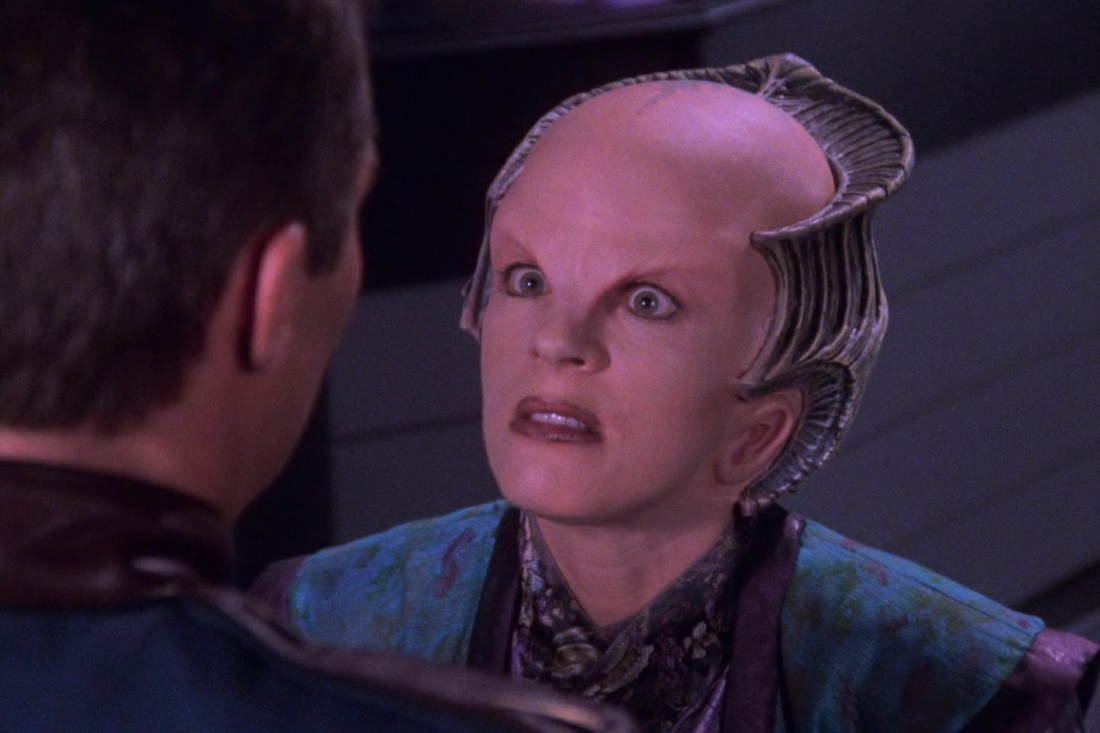
Delenn visits the medlab. She tells Rufus that she’ll tear his ship apart to find his collection of souls and free any Minbari souls she finds. Rufus tells her that he recognizes her as a Satai from the Grey Council, who was there when Dukhat died, and he wonders why she’s playing at being an ambassador when she’s so much more.
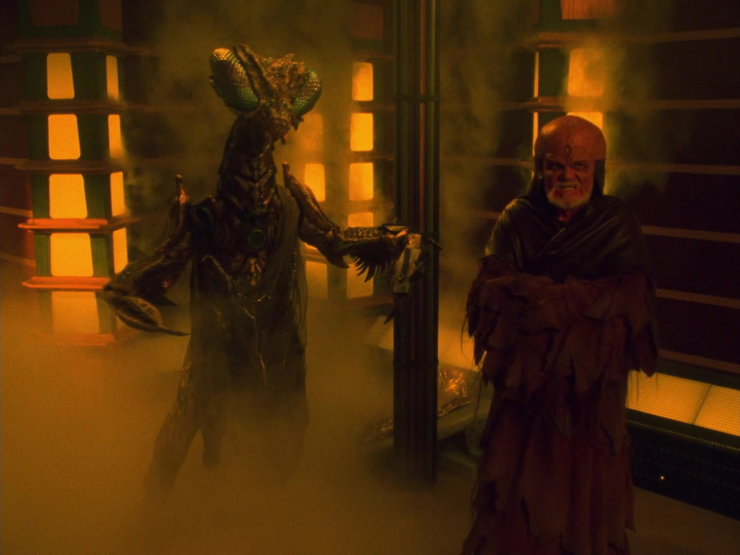
Rufus escapes, injuring one of Garibaldi’s security people in the process. A second Soul Hunter ship—this one intact—comes through the jumpgate. The second Soul Hunter—let’s call him Xavier—says that he’s here for Rufus, who is apparently deeply disturbed. After failing to preserve Dukhat’s soul, Rufus went a bit binky-bonkers, and is now killing people in order to preserve their souls. This is a violation of Soul Hunter law, and Xavier is here to arrest Rufus. Xavier is the one who damaged Rufus’ ship.
Rufus goes to N’Garath, a criminal kingpin in downbelow, who sells Rufus a level-five clearance that enables him to find and access Delenn’s quarters, all the better to kidnap her with.
Aided by Xavier, Sinclair, Garibaldi, and the security force search for Delenn. Xavier is able to sense Delenn’s impending death in a particular section, and, because he’s listed first in the opening credits, it’s Sinclair who finds Rufus and Delenn, the latter being slowly bled to death so that she’ll die semi-naturally and Rufus can take her soul.
Sinclair is able to stop Rufus by turning his soul-sucking machine on him, which kills him. Delenn is brought to the medlab, where she recovers, and Xavier departs, with Sinclair making it clear that Soul Hunters are not welcome on B5.
After she recovers, Delenn takes Rufus’ collection of souls and breaks the globes, releasing the souls.
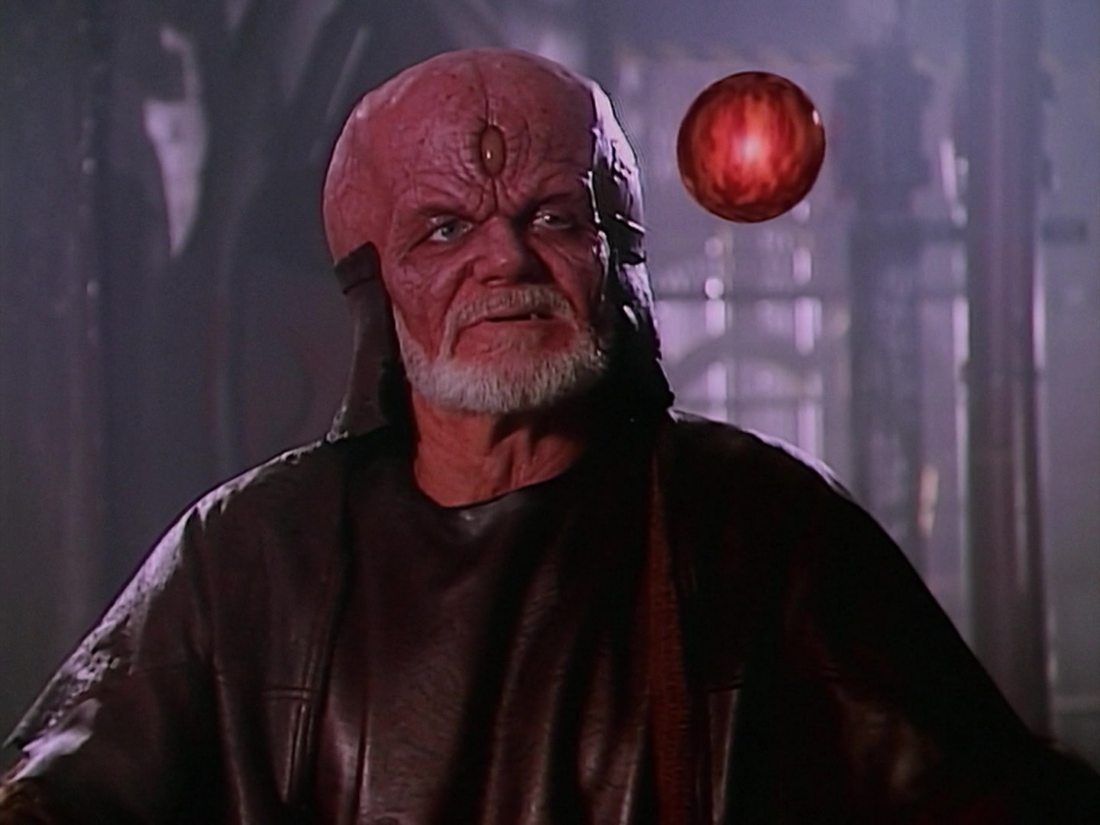
Nothing’s the same anymore. Delenn’s line about how they (meaning the Minbari, or possibly the Grey Council) were right about Sinclair is another hint, along with the “hole in his mind” mentioned in “The Gathering,” that he’s important to the Minbari for some reason.
Ivanova is God. Ivanova’s deadpan and pessimism are both on full display in her interactions with Franklin.
The household god of frustration. Garibaldi’s security guard who is watching Rufus falls for the sick-prisoner trick and gets his ass kicked and his weapon taken, which probably got him fired.
If you value your lives, be somewhere else. Delenn’s response to the presence of a Soul Hunter is to try to shoot him and to generally act batshit. We also get someone else who figures out that she’s part of the Grey Council, and just like G’Kar in “The Gathering,” she tries to kill him (though she did that part first…).
Looking ahead. Rufus sees what Delenn has planned for the future and is horrified. Delenn says before losing consciousness that the Minbari were right about Sinclair, the meaning of which will become clear before long…
Welcome aboard. The late great W. Morgan Sheppard plays Rufus, while John Snyder plays Xavier. Sheppard will return in “The Long, Twilight Struggle” in season 2 as a Narn warleader.
Trivial matters. This episode is Richard Biggs’ first appearance as Franklin. Though they are listed in the opening credits, we still have yet to see Bill Mumy or Caitlin Brown as, respectively, Lennier and Na’Toth.
This is the first mention of Dukhat, the great Minbari leader, whom we will later learn was Delenn’s mentor. It’s established that Dukhat’s death is what got the Earth-Minbari War started.
The echoes of all of our conversations.
“Typical human lifespan is almost a hundred years, but it’s barely a second compared to what’s out there. It wouldn’t be so bad if life didn’t take so long to figure out. Seems you just start to get it right, and then—it’s over.”
“Doesn’t matter. If we live two hundred years, we’d still be human—we’d still make the same mistakes.”
“You’re a pessimist.”
“I’m Russian, Doctor.”
Franklin and Ivanova discussing philosophy.
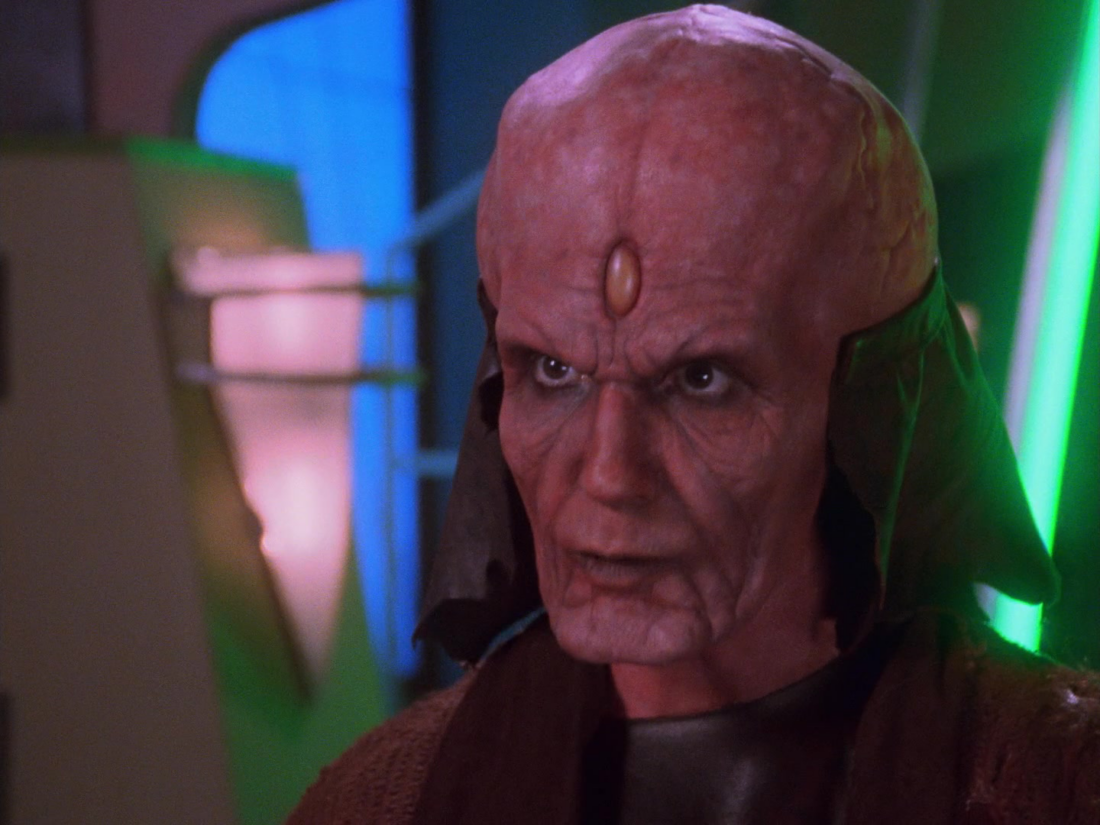
The name of the place is Babylon 5. “The soul ends with death unless we act to preserve it.” Thirty years ago, I watched the first season of B5 and was not all that impressed. I don’t remember specifics, but I remember in particular finding each of the first two episodes to be awful.
On this rewatch, I actually really liked “Midnight on the Firing Line,” but “Soul Hunter” is, if anything, worse than I remember.
Part of what I dislike about the episode relates not so much to the episode itself, but the pre-show hype that B5 had online. Creator J. Michael Straczynski spent a great deal of time promoting the show in advance of its debut on the various online bulletin boards of the era, particularly GEnie and CompuServe, and one of the things that he said would be the hallmark of the show was that it would that it would be scientifically accurate, unlike most other screen science fiction.
And then we get this episode, which starts with a damaged ship coming through the jump gate that, somehow, is on a collision course for B5. At this point, my disbelief needs the Heimlich maneuver, because, as Douglas Adams reminded us, space is big—really big. There’s no reason for the jump gate to be all that close to the station. In fact, it makes sense for there to be a certain distance for safety reasons. Yet somehow, this badly damaged ship winds up on a collision course with the station—which is, in astronomical terms, incredibly tiny—and it’s so close that Sinclair is barely able to grapple it in time (after missing twice) to keep it from crashing.
After that, we get the entire concept of Soul Hunters, which is exactly the kind of fantastical thing that Straczynski was supposed to be avoiding. True, we’ve already got telepathy, which is equally fanciful, but the use of telepathy in science fiction is pretty well established, from Alfred Bester’s The Demolished Man (which, as we’ll see, is a huge influence on the use of telepathy in B5)to Professor X and Jean Grey of the X-Men to the Ghosts in the StarCraft game, so one can forgive it a bit more readily.
But this episode presents the swiping and storing of souls as a real thing that Rufus does. Now, you can argue that it isn’t really what he’s doing—but he’s doing something. His soul-sucking vacuum cleaner enables him to see something in Delenn, so it obviously functions on some level. (Also, does he really need to carry that big-ass soul-sucking vacuum cleaner around every time he does this? Is that really practical?) Heck, the whole idea of “sensing death” is pretty much nonsense, too.
There’s some fun foreshadowing of the connection between Sinclair and the Minbari and of Delenn’s true purpose, and nobody ever went wrong casting W. Morgan Sheppard, but these are very minor good points in an episode that is just awful. It doesn’t help that there’s no sign of Andreas Katsulas or Peter Jurasik, and an episode without G’Kar and Mollari doesn’t bear thinking about.
Next week: “Born to the Purple.”

And yes, had there been a third Soul Hunter, I would have referred to him as Sarsaparilla.
https://youtu.be/wtxRXndvruk?si=ERIbg_V6zwZlHarI
—Keith R.A. DeCandido, who does not have a sister named Rafaella Gabriela
Do you have a rerlative named, “Abrahamo Lincolni”? (I’ll show myself out)
As Captain America said, I understood that reference (but only after the third name).
Doesn’t Martin Sheen play a Soul Hunter in a later episode?
In one of the movies, which I won’t be getting to for a while, so there’s a chance I won’t remember the joke by then.
Not a good chance, mind you……………..
—Keith R.A. DeCandido
Yep. “River of Souls”. Which was made even worse by the (non)acting of the main human character who, according to some older reports was even more clueless (and couldn’t have cared less about his role) than Joan Collins in STOS’s “City on the Edge of Forever”. (actor was Ian McShane).
Oops; sorry krad. I’ll leave the rest for you when you get to it.
Whoa, whoa! Was Joan Collins clueless about her role as Edith Keeler? Was she non-engaged in the process or something? I confess the only behind-the-scenes stuff I know about that episode is the stuff around Harlan Ellison and his “unflimable” script… I have not heard anything about Collins, and I think her performance is one of the best a Trek guest star turned in. I won’t drag us far afield here, but I guess I’ll have to look into that.
I can’t wait to see Jeb Bartlett as a Soul Hunter, though. Does he do a lot of good walk-and-talk? Ask someone, “What’s next?” ;)
That’ll have to wait until River of Souls, I guess.
Yeah, this episode is pretty bad and arguably more nonsensical than I remembered. As you mention, you would think that if Soul Hunters could somehow sense death and try to get there in time to capture the soul at the last minute, it wouldn’t involve a hugely complicated piece of machinery that would need to be transported, setup, and maintained.
Also, one would think that a station like this would have (a) two to three starfurys on patrol at all times and (b) at least a few pilots on standby to launch in the case of an emergency (even if a were not true). The commander rushing to board his ship and prevent the collision course in this instance is much worse than him leading the attack on the raiding party in the previous episode (at least there he had a specific strategic reason to want to be off station)
In at-the-time online discussions, JMS said it was supposed to show that Sinclair had a death wish and kept putting himself in danger. Don’t think it worked.
As we’ll see in later eps (grin), even Garibaldi questons Sinclair on his “need” to be in the front of the firing line.
That’s essentially the point of a discussion between Sinclair and Garibaldi in “Invasion”.
Then again, I wouldn’t blame anyone for wanting to erase that episode from memory.
“Infection”, but yeah it was only memorable for David McCallum and for Garibaldi confronting Sinclair about his need to put himself in harm’s way.
I can see what JMS was going for here. In terms of the Soul Hunters, I think it was meant to be a matter of debate in terms of what exactly was being done by the Soul Hunter’s technology. Is it truly capturing the “soul”, or it is somehow copying the consciousness? But more important to the overall narrative was what Delenn, and therefore at least some of the religious caste, believed about souls. Delenn’s belief is that the Soul Hunter was, in fact, trapping the actual soul, thus preventing those souls from rejoining the reincarnation cycle at the heart of Minbari belief.
The idea that something is going on with that reincarnation cycle – that each new generation of Minbari is somehow lesser than the one before it and the stronger, better Minbari souls are going somewhere else – is pretty important to the meaning that some Minbari attach to Sinclair. And of course, Delenn’s presence on Babylon 5 relative to Sinclair is wrapped up in her fervent belief about him.
Those are the elements that I like about the episode.
I think the Soul Hunter concept was a flawed way of revealing those concepts. So much so that they are conspicuously absent from future events where, by the logic given in this episode, they should have appeared.
The Soul Hunter ships are seen in the flashbacks of Season 4’s “Atonement.” At the time of the later, “In the Beginning” TV movie, the Soul Hunters were NOT seen, but JMS stated at the time that it wasn’t due to changing his mind about the concept but just the timing of that movie. The Soul Hunter attack and the Minbari defense of “a wall of bodies” would have taken too long to set up and carry off and he needed the plot move on to the next thing.
Yeah, this episode doesn’t have a whole lot going for it. That final scene of Delenn breaking the globes and releasing whatever has stuck with me for the last 30 years, but that’s it.
Along with all of Keith’s complaints, the pacing is terrible. Parts drag, other parts are rushed. I guess you could put that down to JMS still figuring out how to write something longer than a half-hour cartoon, but it’s really easy for attention to wander.
One other thing that really bugged me was Sinclair after Rufus knocked him to the ground. O’Hare looks like he’s just lounging there before wondering what’s in the bag next to him. There’s no sense at all that he’s been roughed up. He looks comfortable and like he should be holding a glass of whisky.
It does do a couple of things right, beyond having W. Morgan Sheppard in it. JMS tries really hard to be agnostic about what the Soul Hunters do. Maybe it’s just uploading a brain scan and modeling a personality. OK, it’s pretty clear it’s more than that, but there’s no indication as to who’s right about what happens to whatever it is in those globes. Maybe the Minbari are right, maybe the Soul Hunters are. Hmmm, maybe that’s actually the only thing this episode does right.
i didn’t mind the pacing except for the final search and boss fight. that was ridiculously long and free of tension as it was obvious what’s gonna happen.
One of my biggest problems with the episode is that it was presented as if the souls were really there and being captured. Particularly the fact that Rufus was able to see into Delenn’s mind. And that last scene, while visually very striking and memorable (kudos to director Jim Johnston), is pretty much telling the viewer that Delenn is genuinely freeing the souls. The script may try to be agnostic about it, but the storytelling fails to be so.
—Keith R.A. DeCandido
@krad – agree, this part really sucked in the episode.
My wife was confused by that last scene. She asked, “is that lady having an orgasm? That’s creepy.”
To be fair, JMS had written for one-hour dramas as well before B5. For example, his tenure on Murder, She Wrote.
Or as some of us like to call it, SOOOOOUUUUUL HUNTER!!!!!
Riffable moment: As Sinclair misses the first grapple attempt, “I’m telling ya, these claw machines are always rigged.”
John Snyder will appear again in “By Any Means Necessary” as unsympathetic labor negotiator Orin Zento. The name of the Narn warleader W. Morgan Sheppard will later portray is G’Sten.
Favorite dialogue:
Franklin: Blood pressure is rising. Respiration up twelve percent.
Garibaldi: So that’s good, right?
Franklin: For a human, yes. In this case, it may be good, or he may be hyperventilating before his heart explodes all over the Isolab.
Garibaldi: Ask a silly question, get a silly answer.
[Sinclair and Delenn enter]
Sinclair: How’s he doing?
Garibaldi: Doc says it’s fifty-fifty. Either way, I’d stay on this side of the glass if I were you.
So much initial hostility. I personally enjoyed this one. Then again, I also like the Doctor Who serial Timelash for the same reason so many hate it, in that H.G. Wells get portrayed as a blithering moron. So take from that what you will.
Gee, that dialogue exchange left me completely cold. And I actually adored “Timelash,” mostly for all the teeth-marks that Paul Darrow left on the scenery….
—Keith R.A. DeCandido
Darrow ate a LOT of scenery in “Blake’s 7″…<grin>
Like Brad Dourif, Paul Darrow is good in anything. In case you’ve never heard of it, Darrow was also in Rough Magik, a pilot for a BBC show that never went to series. It’s on YouTube and should be the first thing you get in a search for the title. Just remember to use a K instead of a C.
Left you cold, eh? Huh. I thought it was brilliant humor! :-p But seriously, while I can’t remember what I thought about that exchange on first viewing two+ decades ago, at least on rewatches what I do like about it is that it does help to further establish Garibaldi’s sense of humor. And also something about Franklin’s reaction hints at the Franklin/Garibaldi bromance to come.
I have never loved this episode. I don’t hate the metaphysical/spiritual aspects, for their own sake. The show certainly seems to build some kind of “soul” into its ontology and you either have to accept that or not. I wasn’t exposed to JMS’ online presence until later, so I wasn’t specifically primed to expect a “hard” approach.
But I find the scenery-chewing in this episode a bit irksome. Also, I just never liked N’Grath at all. The idea of having non-humanoid aliens is a good one, but the budget and technical limitations just made it a bridge too far.
I did, and still do, like they way that show hints at its bigger picture by dropping fragments without necessarily trying to explain them. I like the mystery – often more than the reveal – and I think that at this point I was sufficiently curious about what the Grey Council was and why it mattered that Delenn was part of it, but didn’t seem to want anyone else to know that, that I was prepared to keep going.
Yeah, N’Grath was a good idea done in by the limitations of the technology of the era, alas.
—Keith R.A. DeCandido
Thank you. I now think that was my big objection to him/it/her, not to the idea of a really alien alien (we didn’t really know about Vorlons or the Shadows back then).
I thought the costume was very well-made allowing for the show’s budget. It had detailed texture and moving mouthparts, which is more than some productions could manage. True, the head was immobile otherwise, but whoever heard of an insectoid with facial expressions?
Although we do get into credibility issues again, since compound eyes are impractical for anything larger than an insect.
It’s also just not very alien? It’s just a scaled-up insect.
He(it?) also never got much in the way of character development. He’s a generic crime boss who happens to be an insect. That’s it. Just not very interesting to me.
At least they tried to do something more than gluing rubber to an actor’s face. “Scaled-up insect” isn’t very alien, no, but “human with different head features” is even less alien.
If they’d had the budget or technical chops to stick with the character or give him longer scenes, they might’ve developed him more.
What happened to that Mantis maquette?
My conjectures for why the Soul Hunter’s ship (and all the other damaged ships that need to be grabbed for dramatic tension) hurtling towards the station is that the axis of the jump gate needs to point in the direction of the destination because of economic needs like not wasting fuel by making excessive course corrections from the gate to the station.
As for the gate being close, I’d say economies again. This time for air and electrical systems. The less time in transit the lower the costs. Of course the closeness means that a off-station transit queue is not much, but there is little shown of the inbound queue that can hear in the C&C traffic control. Inbound and outbound jump are orchestrated so the ships do not bump or otherwise have the jump field get messed up. Future episodes will show what happens then. Also future episodes will show why ships do not queue in jump space.
That traffic control is done via radio transmission, brings up another possible reason for the closeness. Light speed will start having impacts for traffic control (and remote drones) at any sizable stand-off distance.
Having the jump gate aimed ten degrees away from the station isn’t going to require that much fuel compared to what’s necessary to decelerate the ship to orbital velocity prior to making the jump.
The lightspeed thing doesn’t work, I’m afraid. The gate could easily be thirty thousand miles away and the radio roundtrip would still only be a tenth of a second. The chance of hitting the station over that distance is not so much minimal as utterly implausible — it would literally be as unlikely as throwing yourself at the Earth from the International Space Station and happening to hit a particular building in New York.
Travel time is more of a concern — maybe they don’t want to force ships to carry the fuel needed to accelerate from the jumpgates and then decelerate again near the station. (But, again, fuel is never a concern at any other point in the series… but possibly that’s because of a great many decisions just like this one.)
Also, it’s less cool if you can’t see the jumpgate because it’s a tenth as far away as the moon is from the Earth :)
Wow – ok well being religious I guess this episode didn’t bother me that much. How you deal with the grail episode will be interesting. Certainly not as good as later episodes – we still haven’t gotten to some of the best quotes in the first season. But I didn’t hate this episode nearly as much – but I didn’t spend time on the bulletin boards you mention so didn’t see the hype for accuracy, and to be fair the show is more accurate than say star trek – but it is not a hard sci-fi book that wouldn’t work for TV. Barely works for movies..
I didn’t much care for the “soul” concept either, but the episode was ambiguous about it, showing that different species have different beliefs about what happens to the consciousness/soul after death, and remaining agnostic about which one is correct. Minbari believe in reincarnation, Soul Hunters believe there’s no life after death without artificial preservation. If you set aside JMS’s boasting, which is a metatextual thing and thus irrelevant to an assessment of the text itself, it’s no different from Star Trek‘s business about Vulcan katras, Sargon’s energy globes, and other ways of preserving consciousness post-mortem. Although the episode does seem to side more with Delenn’s beliefs given that ending, and given everything this episode was setting up for the future.
Plus nobody ever went wrong casting W. Morgan Sheppard as a villain. His performance is effectively creepy and weird, so much so that it seems incongruous that Soul Hunter #2 just talks and acts like a stuffy English butler.
There were things that bugged me. The “collision course” bit was silly, as was Sinclair going out to catch the ship personally — although I like it that they used a plausible rendezvous method of matching course and grappling rather than using a “tractor beam.” (Although a more plausible method would’ve been to attach some thruster drones to the derelict and bring it under control that way.) Soul Hunter #2 being able to translate his directional death sense into a location on a map was kind of implausible — he didn’t know the station well enough to make that kind of spatial adjustment, I’d think — and the station’s so big that the general area covered by his fingertip would’ve been about the size of a city block, not narrowing it down much.
I was also bothered by the line about the Hunter going to the “Alien Sector” because he’d draw too much attention elsewhere. That’s incredibly human-biased thinking, as if all aliens blend together. Surely the Soul Hunter would be just as alien to every other species as he was to a human, so he’d stand out just as much, particularly since many of those species are more familiar with the Hunters than humans are. Really, the whole concept of having just one ghetto-like “Alien Sector” on a station whose whole professed purpose is to promote interspecies unity is just so ugly and human-centric.
The creature effects for N’Grath the information broker were more impressive than I remembered. The design is too derivative of a preying mantis, but the sculpting and execution are good, and the suit performer (Russ Johnson, according to the B5 wiki, though the voice is uncredited) does an impressive job creating an alien body language, so it doesn’t just look like a guy in a suit. I respect the effort to create a non-humanoid alien, and it’s disappointing that they gave up on it after half a season.
I wasn’t so impressed by the prop design, though. The Soul Hunter’s consciousness extractor was very cheap-looking.
Sheppard best known as MacGyver’s resident Hannibal stand-in, Dr. Zito.
I remember Sheppard as Dr. Zito, but I wouldn’t say that’s what he’s best known for. He was Blank Reg in Max Headroom, Ira Graves in TNG: “The Schizoid Man,” a Klingon prison warden in ST VI, a Captain Ahab figure in Voyager: “Bliss,” the villain in the Elvira: Mistress of the Dark movie, the old version of Canton Delaware (played by his son Mark Sheppard) in Doctor Who, the voices of Odin and Petros Xanatos in Gargoyles, etc. Wikipedia says one of his best-known roles is “the Confederate general Isaac R. Trimble in the films Gettysburg and Gods and Generals.” And before that, he was a Royal Shakespeare Company associate for 12 years.
Also, apparently Sheppard was a runner-up for the role of G’Kar.
“I was also bothered by the line about the Hunter going to the “Alien Sector” because he’d draw too much attention elsewhere.”
To be fair, if there is an sector full of humans and a sector full of aliens, an alien should show up less in the alien sector simply because the background there is more varied.
Except we see aliens all the time in the “human sectors” of the station. Calling it the “alien sector” is deeply problematical — it’s really the sector for diverse environmental needs. It’s supposed to be a cosmopolitan port of call for everyone, not a human territory with a segregated sector for nonhumans. Humans are aliens to everyone else, after all.
This is true, but then again, one of the themes of B5 is that humans haven’t actually grown any more enlightened and will take all of our many issues out to the stars with us. Also, all the security personnel on the station looking for this guy are all human …
Yeah, but the inhabitants of the “alien sector” aren’t just passive extras (or aren’t supposed to be). Given what we were told, many of them would presumably know about the Soul Hunters and react with intense fear and revulsion at the sight of one. It’s a basic principle that you can only hide out among a population with their cooperation. If they don’t want you there, they won’t protect you from the authorities and may well rat you out to them, if not drive you out themselves.
On prop design: the thing plugged into Delenn’s ankle is 100% a “solder sucker” style pump desoldering tool, and breaks any immersion I might have every time I see it.
I was able to watch it – unlike some ST:ENT episodes – but with great suffering. However Sheppard was really great in the role and that helped me through it this nonsense. Was it mentioned in the review that the whole station was able to afford 3(!!!!) people to search and save an ambassador and that included the commander and the chief of security. This feels even worse than on DS9, where Odo sometimes at least seemed to have people in security…And of course it was the commander out of the three who ran into the evil guy with Delenn, who else?
The part I skipped through was this search and the Big Boss Fight – it was obvious that neither Delenn nor Sinclair can’t get into serious trouble at the beginning of the series, so it was totally meh…otherwise the episode at least had an OK flow and the cliché of questionably neutral or evil guy going totally evil and killing people actually kinda worked at least…
The incompetent security guy in the sickbay was total copy from any Star Trek episode…
Nah; his shirt wasn’t red…
This episode introduces N’Grath which makes it pretty awesome. My wife and I cheer, “Fly Guy!” Whenever he/she/it appears on screen.
But he’s a Mantis Guy.
Don’t be such a pedAnt.
This thread is really starting to bug me…..
—Keith R.A. DeCandido
I thought it was Draal who was Delenn’s mentor? Not that we’re limited to one.
Well, he was, but it always seenmed that he and Delenne were as much friends and equals as mentor/mentee. Whereas there is little doubt as to what Dukhat meant to her (“I can’t have an aide who is always looking at her feet…” – paraphrasing)
Both of them were, presumably at different phases in her career.
I actually like this one. I think the Soul Hunters are an interesting bit of worldbuilding, and I think it does a fair job of establishing, right from the jump, that religion will be a key theme of this series going forward. As for the matter of souls, I know that Robert J. Sawyer did a pretty good hard SF treatment of what might happen if physical evidence their existence was ever discovered at around the same time, so maybe it was just something in their air ca. 1994. Personally, I find it considerably more plausible than the depiction of telepathy.
This is precisely why I like this episode, too. Agreed that the open creates artificial tension, though certainly B5 isn’t the only show to do that, and the open isn’t something anyone is thinking about after we meet the Soul Hunter and Sheppard’s arresting performance.
What this episode does is declare that religion as belief is going to matter in this show, not just as cultural set-dressing but in a significant way. And while it may mishandle… well, everything, as much of the first season does between looking cheap and the human cast not having dialed in their performances yet (though Biggs is good here), attacking the central conceit of the soul as “unscientific” and complaining about where the jump gate is located while accepting faster-than-light travel and communications is one of those odd things that sci-fi fans do. (I accept that finding that irritation as a Trek fan reading JMS’s posts at the time might make one more sensitive.)
So here, in fact, is what we know on the basis of the evidence on-screen:
Both Soul Hunters and Minbari believe that souls exist and that Soul Hunters can capture them. The former believe that souls die unless they are saved; the Minbari believe in reincarnation. Franklin is an interested skeptic. Neither the Soul Hunters nor the Minbari offer any scientific proof of a soul.
This Soul Hunter has a number of spheres that appear to be inhabited by glowing lights of some kind. They have a limited capacity for movement with no visible mechanism allowing it. No character who does not already believe in souls interacts directly with these spheres. When Delenn opens them at the end of the episode, there’s no visible mechanisms revealed and something appears to be released which then fades away, potentially some form of energetic particles.
This Soul Hunter has a bulky device he uses to capture souls. He claims that it can rip a soul out of a body (and it does, indeed, seem to kill him later in the episode). Hunter 2 makes clear that the first Hunter is not doing the normal Soul Hunter thing: it’s possible this device is an invention of the murderous Soul Hunter and not the normal way of handling things.
And that’s it. We know beings with energy-like bodies exist in the B5 universe. We see no evidence of any soul in any episode without a Soul Hunter, excepting Vorlon-style bodies. If the Soul Hunters scan brains and generate artificial versions of people, the “vision” this Hunter gets from Delenn is no more mystical (or proof of the soul) than any telepathic scan; it offers zero proof of the soul’s existence.
I also very much like the ambiguity of the ending. As shot and with the background music, it’s clear Delenn is joyfully releasing these souls back into the cycle she believes in. Given that some of these souls were forcibly taken, it seems likely that they, at least, would desire that. But volition is purely implied: nobody communicates with any of these souls to determine their wishes, and we can see that only some of the Soul Hunter’s souls intervene to stop him, while others remain in his sack. It’s equally possible Delenn is murdering preserved people against their will, or ending sophisticated nanotech artificial people’s lives. She might even be liberating some and ending others against their will.
This is not the worst thing Delenn does on screen in this series. One might note that in her first three appearances, she’s twice tried to commit murder. And I think, on balance, we’re meant to see the ending as happy, but it’s happy with a heavy question mark.
My take on Franklin is that he’s on the fence regarding whether or not souls exist. But if they do, he finds the idea that they could be hoovered up into a glass ball preposterous. We’ll see this attitude again in “Believers”, when he tells the kid that a soul isn’t something that will leak out just because a surgical incision got applied to your abdomen.
I’ll buy that the existence of a soul is more plausible than telepathy, but I would argue that telepathy is more plausible than the soul being a tangible thing that can be sucked out of you with a big zappy thing.
—Keith R.A. DeCandido
O, ye, of little faith! <snerk>
Keith, I would argue that over time, telepathy will be possible among humans. After all, we use less than 5 percent of our actual brain power. So it could be possible that we will develop new abilities as time goes on. How much in a little over 230 years from now is definitely debatable, though I don’t think we are told how or when telepaths developed among humans. Who knows? Maybe the Vorlons had agents who did something and put something into the water of a selected or random person here and there.
As Christopher said, Gary, the notion that we only use a tiny percentage of our brain has been thoroughly debunked as purest hokum.
—Keith R.A. DeCandido
“After all, we use less than 5 percent of our actual brain power.”
That’s a complete myth, which has been decisively debunked by modern brain-scanning techniques proving that we use all of the brain.
https://science.howstuffworks.com/life/inside-the-mind/human-brain/ten-percent-of-brain.htm
After all, why would evolution waste resources growing and maintaining so much brain matter if we never used it? It’s obvious nonsense if you think about it, but it’s popular with fiction writers who want an excuse for mental superpowers, and with con artists and hucksters trying to sell people on snake-oil methods for boosting their brainpower.
One explanation I read once for the basis of the myth is that it started with an early attempt to measure sensory and motor neuron activity in the brain. It only detected those particular kinds of activity in about 10% of the brain, meaning the other 90% was probably devoted to actual thinking, feeling, etc. Their published results said that 90% was “quiet,” meaning it didn’t show the specific narrow types of activity they were able to scan for at the time; but the news media are always stupid about science, so the press misinterpreted it as saying that 90% of the brain did nothing at all, and the public latched onto that mistake and refused to let go.
Besides, evolution is not a magical “upward” ascension, it’s an adaptation to the demands of one’s environment. We have no environmental incentive to develop direct mind-to-mind communication, especially since we’ll be able to achieve it with technology before much longer. Also, evolution can’t break the laws of physics. Reading the activity of a moving brain from a distance is prohibitively hard, especially with an antenna no larger than the brain itself.
Not to mention that reading someone else’s brain activity directly would only give you limited comprehension, since so much thought and knowledge is stored in a web of associations that’s unique to each brain. Universal things like sensory perceptions and emotions might be readable, as well as subvocalized thoughts as long as you understood the language they were in; but otherwise, individual thoughts would probably be incomprehensible. The trope of telepathy as the key to transcending language barriers gets it backward; a common language is the only way to transcend the barrier between two different brains’ idiosyncratic codings.
No, the only telepathy we’ll ever have is technological, if we use implants to connect our brains through the information network.
I’d say it’s the other way around. Telepathy only requires positing some mechanism for signal exchange between brains, as well as a mechanism for decoding the signal. Both are implausible if you dig into the details, but the basic idea is quite simple, just a form of communication. Positing some incorporeal template for a conscious mind that can exist independently of the brain’s physical substrate is a far bigger and more improbable leap. By analogy, the former is like saying your computer is equipped with wi-fi; the latter is like saying your computer software can exist independently of any kind of CPU or drive.
I mean, usually in these stories, the postulate is that the disembodied consciousness exists as some kind of neural or psychic energy, but energy isn’t something that exists independently — it’s a property possessed by particles. When we talk about “pure energy,” that’s shorthand for massless particles like photons, which are constrained to travel at the speed of light and thus couldn’t possibly hover in place or form any kind of organized neural network that could possess consciousness. Only something made of particles with mass could do that — something like a brain. So talking about consciousness existing separately from the brain housing it is magical thinking. The closest you could get is what Dr. Franklin suggested: scan the brain and create a copy of its neural network in a computer. But that’s not a “soul” in the sense of an incorporeal consciousness.
I guess you could posit some kind of undiscovered psionic particles that exist within the brain and can separate from it, retaining the neural-net organization that embodies the consciousness, but that requires more ad hoc postulates than telepathy alone does, so I would call it even less plausible than telepathy.
I think you could interpret the lights in the spheres as being a plasmatic medium of some kind. And if you have a machine that can, for example, somehow copy the information about every neural pathway in your brain while necessarily destroying the original (almost like a sort of quantum teleportation process), then I think that it would at least not be unreasonable for the Minbari or the Soul Hunters to interpret that information as being your soul itself.
Anyways, that’s my headcanon for how it works.
That makes relative sense, but it would mean that Delenn was just killing the captured minds by releasing them and allowing the plasmatic substrate to dissipate.
Anyway, I’m uneasy with the word “soul,” not only for the religious connotations, but because I’ve never found a consensus definition for what the word actually means. Sometimes, as in this episode, it seems to be equated with a person’s consciousness and identity, but sometimes you’ll see fantasy stories about people who have lost their souls but still have their memory and personality. And in Shintoist and other animist beliefs, nonsentient inanimate objects can have souls. It’s a word that people use while just assuming its meaning is known, so its use is often vague and inconsistent, and people can talk past each other if they’re not using the same definition.
The possibility that Delenn is killing those “trapped” in the spheres is exactly what the Soul Hunter accused her of wanting to do. I think that is somewhat the point. Delenn is incredibly pleased to free the souls because of her belief system, but is it so clear cut? From a certain point of view, Delenn is a religious fanatic. (I seem to recall that even among the religious caste, her choices are eventually remarked as being unorthodox and questionable.)
On paper, I agree, it’s ambiguous. But the way the final scene is directed and scored seems to endorse Delenn’s view that this is a good thing.
and this is a problem why? Seriously? Why can a sci-fi show not embrace spirituality in some form? I had the same problem with people that didn’t like the ending to the new Battlestar galactica. Expecting all sci-fi to be atheist is not something I understand.
The problem with the ending to BSG was not that it brought in deities and angels, it’s that the writers tried to use deities and angels as a “get-out-of-jail-free” card to avoid having their plot have to make sense. BSG pretended to have a long-term plot like B5 and then it turned out that the writing team was always just playing it by ear.
As I said at the time, in reaction to the opening line “The Cylons have a plan”, “Yeah, and someday they’ll share it with the writers.”
That’s not true at all. The religious element was always there, with characters being guided by beings that literally called themselves angels doing God’s will, and with prophecies and cycles of destiny and tons of things that had no rational explanation. But because it was dressed up with space-opera trappings, the audience — myself included — convinced ourselves that it all made rational sense somehow and the talk of God and angels was untrue. But the show told us all along that it was set in a magic-realist universe where God existed. It may have left it ambiguous, but like any mystery story, it gave us the clues all along even if we didn’t recognize them at the time.
I mean, really, why should we have expected otherwise? The original BSG was a parable for Glen Larson’s Mormonism. It was originally going to be titled Adam’s Ark — it doesn’t get more religious than that. And it featured entities that were essentially angels (the Beings of Light) and Satan (Count Iblis), though to get around 1970s network censors it had to handwave them as highly evolved godlike aliens and advanced technology indistinguishable from magic. The reboot wasn’t under such censorship, so it was free to come out and say God and angels existed in its universe. The fact that the audience spent four years disbelieving the characters who called themselves angels doesn’t mean the religious elements were a last-minute retcon; it just means we were wrong to disbelieve what they were telling us consistently for years on end.
It’s not a problem if the intent was to endorse Delenn’s view. The point is that if the script’s intent was instead for it to be ambiguous, the direction didn’t achieve that intent. It’s not about shows in general, it’s about whether this specific episode was successful in getting across its intended message. What we’re asking is, was the episode meant to be ambiguous on the subject or not? The script implies that it was, while the direction of the final scene seems to go against that.
Besides, as Keith said in the review, part of the issue is that JMS made a big deal in the press and online about how much more scientifically accurate this show would be than other SFTV. So it’s not about whether other shows can embrace spiritual ideas, it’s about the explicitly professed goals for this show and whether it lived up to them.
“There’s no reason for the jump gate to be all that close to the station. In fact, it makes sense for there to be a certain distance for safety reasons.”
I would think it would make sense to put the station behind the jump gate, just in case.
I didn’t find the idea that Soul Hunters could “sense death” to be any more ridiculous than the idea that Centauri could have visions of their own deaths. Both are just limited and rather morbid forms of precognition, so if you’re going to have the one, why not the other? And if you are going to be able to sense when it’s going to happen, you might as well be able to sense where.
As for the concept of soul-sucking machines, yeah, that does sound ridiculous, but the transferring or preserving of consciousness is as much a staple of science fiction as precognition or telepathy. Most writers just use a less loaded term for the process. I don’t think any of these concepts are particularly scientific, but I wasn’t aware that the writer had promised his show was going to take itself so seriously, and that’s certainly not the tone it’s tried to strike in its first few episodes.
The most fantastical element of the episode is the Minbari concept of reincarnation, but I think the episode was pretty ambiguous about whether or not it was true. It presented different species as having different opinions on the matter, with the Minbari believing in reincarnation, the Soul Hunters believing souls needed to be preserved in order to survive, and most humans apparently not believing in souls at all. Of course, I have no idea where the show is going with this, so I should probably reserve judgement on the concept unless and until it takes an explicit side.
Setting all that aside, the episode itself wasn’t especially enjoyable. W. Morgan Sheppard was obviously going for creepy and fanatical, and he certainly was that, but his performance was so creepy and so fanatical that I never actually connected with him as a character, which is a big problem when he’s arguably the main character of the episode. I was also a bit annoyed by the fact that the only part of the episode that seemed to be advancing the larger plot (which is supposed to be the thing Babylon 5 has going for it) happens in a brief scene the very end, with Sinclair discovering that Delenn is a member of the Minbari ruling council, and then it’s just dropped, with Sinclair saying “there’s always time” to look into it later. It’s like the writer is admitting that he’s just stringing the audience along.
Mostly agree, until your final half-paragraph; it wasn’t just at the end that we get that foreshadowing. It’s throughout the episode – frex, when Delenn first sees the Soul Hunter, and he greets her as Satai Delenn. The whole concept of “souls”, what Minbari believe and what relation Delenn, the Grey Council, and Sinclair have is central to the entire episode.
IMO, of course.
FWIW, without getting into any spoilers, the Minbari belief about souls does tie into the larger tapestry. From a certain point of view.
Good to know. I suspected that they wouldn’t introduce the concept just for this rather disposable episode.
“I was also a bit annoyed by the fact that the only part of the episode that seemed to be advancing the larger plot (which is supposed to be the thing Babylon 5 has going for it) happens in a brief scene the very end,”
That was never supposed to be the only thing B5 had going for it. It was always an episodic series by design, just one where the episodes gradually built up to something bigger. At this point, the foreshadowing and worldbuilding are just a background element to the episodic stories — kind of like the post-credit scenes in the first few years’ worth of Marvel Cinematic Universe movies, where they were just minor hints and setups that were incidental to the individual stories being told, and it wasn’t until years later that you could look back and see how they planted the seeds.
I suppose it’s just not what I was expecting. The word “episodic” was never used by anyone pitching the show to me over the years. They’ve always emphasized the opposite. I’ll just have to adjust my expectations going forward.
Except for the standalone episodes, it never was episodic (though there were more of those standalones in S1) Each episode, while self-contained, advanced the “novel” JMS was writing.
Perhaps Christopher and I have different meanings for “episodic”.
Oh, definitely. “Episodic” does not mean, and has never meant, that there is a total absence of continuity. It simply means that each installment tells a story with a beginning and end, rather than merely an incomplete fragment of a story as in a pure serial. Individual episodes absolutely can and do add up to a larger narrative arc — look at Star Wars Episodes I-IX.
The problem is that people have this bizarre need to reduce everything to black-and-white absolutes, creating the false premise that episodic and serial storytelling are diametric opposites, when actually looking at the structure of most ongoing series shows they have a blend of both elements. There are countless episodic series that have developing continuity, whether of plot or character. There are countless story arcs that are subdivided into individual cases-of-the-week while developing a larger continuing storyline for the main characters on top of it.
In a fully serialized show, if you have multiple different story arcs, then each individual installment will advance all of them a little bit simultaneously. But B5 didn’t work that way. One episode would be devoted to one story thread which would be wrapped up by the end of the hour, then the next episode would shift focus to a different story thread that would be wrapped up in that hour, and so on. The story threads would advance over a season or over the series, but in discrete steps, one complete episode here and one complete episode there, with the focus shifting to other threads in different episodes, rather than all of them being advanced at once in every episode.
So yes, absolutely, B5 was an episodic series and a serialized series, because it’s wrong to call those opposites. The best stories work on more than one level. If you’re going to tell a story in installments, it’s better to make each installment feel complete in itself rather than just be a fragment. It’s better to make each one individual and memorable in itself rather than just blending into a generic mass. In a lot of modern serialized shows, you can rarely pick out any single episode as particularly noteworthy or memorable. In B5, the individual pieces stand out as much as the overall whole. That’s why it does it an injustice to deny the episodic aspect of its structure.
I see B5 as an episodic series with multiple story arcs — some that carry through longer than others.
People exaggerate B5’s serialized nature, because for some reason people insist on thinking of episodic vs. serial as an all-or-nothing question, even though countless series are a mix of both. B5 is not actually a serial, which means a single plot told in multiple installments. It’s an episodic series whose episodes advance its story and character arcs over time and add up to a larger continuous narrative. It’s not unlike Deep Space Nine in that regard; the main difference is that the overall narrative was planned out in advance and divided into seasonal “chapters,” pioneering the season-arc format that’s now common. It’s a lot like a modern episodic show such as The Flash or the Quantum Leap reboot, where each episode tells its own complete story but there’s a larger story building up bit by bit and coming to a game-changing climax at the end of each season. But that format was novel for the time, so the show still feels a lot like the episodic series of the era such as ST:TNG, since that was what audiences were used to.
In addition to what CLB said, IIRC Season 1 is much more on the episodic side, with the later seasons becoming more focused on the through storyline but still having the occasional “side quest” episode. When I’m re-watching S1, I’m always struck by the little details that are seeded in every episode that end up bearing fruit later. Some (like Delenn and the Gray Council) are obvious, some are more subtle, but every episode has them.
Or at least that’s what I remember. It’s been a long time since I’ve re-watched B5, so I’ll be interested to see how well my recollections match up with reality.
I think you’re right. And of course, it makes perfect sense. You care more about an ongoing story if the series takes the time to let you get to know the characters and their world before it gets into the weeds. The connections between the parts don’t matter if you don’t care about the parts.
I actually appreciate that Babylon 5 is willing to use the loaded word “soul”, rather than something like Voyager’s episode “Cathexis”, which presents basically the same thing but tries to pretend that it’s not by loading it up with technobabble.
It certainly doesn’t bother me, but I can understand why it might feel out of place to some sci-fi fans. Sometimes a patina of technobabble is required to get people where they need to be to enjoy a more metaphysical story.
I think that’s what they were trying to do with Dr. Franklin’s skepticism and proposal of an alternate explanation for transferring consciousness, so you could believe that’s what was happening. But it was very much a story about the clashing religious beliefs of two alien cultures. It wasn’t so much saying “This is objectively true” as saying “These are the beliefs that drive these characters and put them into conflict.” It even made a point of showing that there are opposing beliefs about what souls are and how they work, which drives home that it’s all subjective. (Although it did an imperfect job maintaining that balance.)
So I don’t really have any issue with the “scientifically accurate” B5 giving us souls and soul hunters, and not least because the Minbari’s beliefs around souls are a critical plot point for the entire series. One of the main threads running in the background of the first season is that there are things in the universe that the younger races, and particularly us humans, do not understand. Human technology is always shown to be pretty scientifically plausible, but the much older races (and the soul hunters are considered ancient by the Minbari, so they’ve been around a really long time), get to play with things that our science can’t explain, and this is the first time we see that. Even the telepaths will be shown to be the result of a several billion-year old advanced race messing with the genetics of the younger races to produce them, rather than some natural phenomenon.
I also like that it is just us humans who are completely clueless about the soul hunters. Delenn’s reaction was covered, but they also note many of the other aliens on the station are in a rush to get out of the area once they learn the soul hunter is on board. It is another subtle sign that humanity has only just begun to really be out and about in the galaxy and is basically clueless about such things.
As for the machine, I figured most of it was Rufus’ own design to slowly murder his victims to try and get the “souls” with as little damage as possible, rather than the standard equipment the soul hunters normally use when they just show up at deaths they are not actually responsible for.
And while it is just a minor thing, I have always wondered if Xavier was sensing Delenn’s potential death, or Rufus’? He sensed a death coming, and there was a death. Would his sense have worked if nobody wound up dying?
I can buy the idea of alien science being capable of things we don’t understand, but only up to a point. For one thing, they shouldn’t violate the laws of physics that we know are accurate. New physics doesn’t erase the old laws, it just adds new dimensions to them or reveals how they change in exceptional conditions. For another, I don’t find it plausible that alien science far beyond ours would just happen to produce results identical to ancient human superstitions about things like souls or magic or whatever. What are the odds that our distant ancestors would’ve just happened to guess right about so much?
And yes, I agree that the death sensed by Soul Hunter 2 was meant to be the death of SH1. That’s how a lot of death-prophecy stories go.
Regarding how alien science would just happen to produce results that would match ancient human superstitions, I believe we are given the answer at the end of season two, when another of those ancient superstitions, or at least someone playacting as one, shows up. Basically, not all of those ancient superstitions were guesses. Some were deliberately planted.
Which is an extremely corny and overused idea, and is just a way to make a sci-fi excuse for rehashing old superstitions rather than imagining something new.
very much disagree but I see you don’t like this show much as what we are talking about here is very much a central core of the show. Suppose I shouldn’t be all that surprised looking back at the differences in the trek episodes you liked that I did not and vice versa *shrug*. Before B5 I hadn’t run into the idea of stuff being planted in various alien races by a more advanced one before – and myself I don’t find the idea corny and the best sci-fi in my opinion takes things me have now and finds interesting explanations for them – but then I don’t consider religion a “superstition”.
I’ll never understand it when people assume a reviewer doesn’t like a show just because they criticize certain aspects of it. Nothing is perfect; you can love something and still criticize its flaws, because you care enough to be disappointed that parts of it fall short of the quality of the other parts.
Besides, I’m not talking about any one specific show. I’m just making a general observation about how the trope of super-advanced technology coincidentally resembling ancient human beliefs is an overused one and something of an excuse to fall back on old ideas rather than imagining new ones. Individual iterations of a trope can still be well done, but that doesn’t mean the trope itself isn’t overused.
“Before B5 I hadn’t run into the idea of stuff being planted in various alien races by a more advanced one before”
That’s quite a pervasive trope in science fiction. Star Trek and Doctor Who both used it on multiple occasions. And there was a fad in the ’60s-’70s to believe in “ancient astronauts,” aliens that came to Earth in antiquity and were responsible for building the Pyramids or drawing the Nazca symbols or otherwise giving ancient cultures their knowledge, or creating humanity as a whole. (Although a lot of that, unbeknownst to many of its adherents, was coded white-supremacist rhetoric based in the belief that non-white cultures lacked the intelligence to achieve great things on their own.)
The point, I suppose, is that for all that JMS played up B5 as a new, fresh take on SFTV, it still relied on a lot of well-worn concepts from older science fiction.
Indeed, picking something that is unaccountably in the press right now, the Bene Gesserit did exactly that sort of thing routinely with their Missionaria Protectiva, distorting and introducing whole cultures’ religions just in case one of their people got stranded there and needed a leg up.
I do love the Soul Hunters’ makeup design.
To each their own. I personally found it too reminiscent of the Funny Foreheads popularly associated with the Trek franchise.
This episode also gives us recurring Bad Alien Design Nagrath, whose only line seems to be expensive.
Bug man? I thought his design was charming.
This episode is one of the many reasons I’m glad I didn’t stumble on the show until Season Two.
I always want to like this episode, for reasons others have mentioned: the Soul Hunters, N’Grath, and a few other elements present some interesting possibilities both in terms of B5-specific world-building and in trying some new directions for SFF TV. But as Keith has pointed out in multiple other rewatches, interesting concepts cannot make up for poor execution.
And yet this isn’t even the worst episode of the series! That’s coming up in a couple weeks.
“Infection”, “Soul Hunter”, and ”Midnight on the Firing Line” were all written before any filming had started with any of the series cast. The lack of vetting from the cast & crew who would actually have to make the episodes may somewhat explain—-but not excuse—-why two of them clunk so badly.
I don’t think that follows, because no TV or movie script is ever immutably locked down. Rewriting happens constantly throughout production, and even into post-production, since changes can be made through editing and dialogue looping, if not through actual reshoots if the need, time, and budget are sufficient. So feedback from cast and crew can always be taken into account if the suggestions are good enough, and if something is noticeably not working, there are options to fix it on the fly.
However, this early in a new series, the cast and crew are more or less equally in the process of getting a feel for the show and trying to figure out what does and doesn’t work. Some of the actors, for instance, are still noticeably searching for their characters’ voices and haven’t quite settled in to the versions we’ll know later. Also, this is the first episode directed by someone other than Richard Compton, so Jim Johnston would’ve been feeling his way too. (At first, I got him mixed up with Joe Johnston, the director of The Rocketeer and Captain America: The First Avenger. Just imagine if they’d gotten him instead.)
I’ve never worked in TV production, but I’ve gotten the impression over the years that “fix it in post” is not as simple as you make it out to be! Production timelines probably make fixing flaws in a screenplay easier for movies than TV.
You are right of course that TV storytelling is a collaborative process, with the result that the first few episodes of any TV show are normally of uneven quality while the actors and writers find their voices.
But here is a situation where the showrunner has specifically mentioned that the first batch of scripts were effectively written “on spec”, lacking in proper collaborative feedback due to the post-pilot production schedule; and that the lack of a fully functioning collaborative process meant that some flaws in those early scripts were not recognized until they were too late to fix. I always found it notable that JMS commented upon a specific aspect of the creative process as a significant problem rather than just vaguely handwaving at Early Season Weirdness. (Although he seemed to stop short of owning up to his own need in that first season to figure out what the hell he was doing and start living up to his pre-release this-show-will-be-different bluster!)
Not in post — scripts are rewritten during filming all the time. There’s an established system where each new draft is printed on different-colored pages so the cast and crew know when the latest changes have come in. Often those changes are made because of suggestions from the actors or director, say, pointing out that a line is hard to deliver as written, or that the actor doesn’t think the character would say it. Or the director may hit upon a better way to convey an idea, or there may be a production issue that requires a change (e.g. it’s rainy so an outdoor scene is rewritten to be indoors, or a creature effect didn’t work as well as hoped so the creature’s scenes are cut down, or whatever).
One of issues in last year’s writers’ strike is that it’s become common for productions to exclude writers from being on set during filming, and part of why writers objected to that is that it undermines a production if writers aren’t on hand to be able to make rewrites on the fly in response to the issues and opportunities that arise during filming. It’s supposed to be a normal, everyday part of the process for writers to work with the cast and production crew to refine the script as it’s filmed, because the script is just a best guess and it always has to be adjusted in the face of on-set realities. (As J. Michael Straczynski himself is fond of quoting, “No plan ever survives its first encounter with the enemy.”)
“But here is a situation where the showrunner has specifically mentioned that the first batch of scripts were effectively written “on spec”, lacking in proper collaborative feedback due to the post-pilot production schedule; and that the lack of a fully functioning collaborative process meant that some flaws in those early scripts were not recognized until they were too late to fix.”
Okay, that suggests it’s more a matter of the production simply being too rushed to allow the normal process of revision during filming. It doesn’t mean the cast and crew couldn’t vet them at all, just that there wasn’t time for addressing deeper systemic issues that would require massive rewrites, and they had to settle for what minor changes they could make on the fly.
Or else JMS was just making excuses. I get the sense that a lot of his online discourse back then was kind of defensive.
That never happened on B5 though. Scripts were *always* done prior to shooting. They only had overtime on shooting something like twice in the entire run of the show because of it. It’s part of how they stayed on budget and were able to keep the show going with substantially less money than trek.
Yes, obviously it’s normal for scripts to be written before filming, usually several drafts’ worth. But that doesn’t preclude them from being revised as necessary during shooting. Nothing is ever immutably locked down, because all creativity is a process of revision as you try things out and discover things along the way. As I said, it’s entirely normal and beneficial for a script to be revised continuously during filming, such as improving the wording of lines to make them easier for actors to say or better suited to a given character’s personality, or adding dialogue to clarify something that the writer took for granted but that the cast and crew find vague. Revisions are good. They make a work progressively better. You want to be able to adjust a script while you film it, just like you want to be able to adjust a set design or a costume design or the way an actor delivers a take. It’s all trial and error and discovery along the way.
As the saying goes (and I think I got this from JMS’s book on scriptwriting), “Art is never finished, only abandoned.” You keep revising and refining it until the last possible moment. Heck, most creators will happily continue to alter the work even after its release — look at all the directors’ cuts out there, all the films and novels revised or re-edited on re-release.
I have heard that TNG was sometimes still writing the first draft of the scripts during filming but I have no idea how reliable the information is. If it is true, I don’t know if it was a common affliction of SF shows of the time.
That sounds unlikely, but you might be thinking of “The Neutral Zone,” which was filmed during the 1988 writers’ strike so that it had to be shot from a first draft that was written in haste from an unrevised outline in order to finish before the strike began (which is why the episode is such a mess). But it wasn’t written during filming; just the opposite. Rewriting during filming is normal, but the strike prevented it.
The 2009 Star Trek movie was also filmed during a strike, so J.J. Abrams had to film the script exactly as it stood as of the start of the strike, and couldn’t revise it along the way. The strike was resolved in time for post-production, so he was able to make some adjustments through editing and dubbing in new dialogue.
Somehow, I knew the grappler scene was going to be picked apart. It always stood out to me, especially because of O’Hare’s rather monotone delivery during what’s supposed to be a rather tense scene: Activating grapple; Negative contact on grapple. It’s essentially a scene designed to teach the audience about their new ship-saving gizmo, create some unnecessary tension out of nowhere, and is also an excuse for Foundation to showcase some of their nifty VFX work.
I still enjoy the episode, and any B5 or Trek episode that has Morgan Sheppard in it – he more than delivers on the threatening nature of the character, and Stephen gets a nice welcome introduction. I like it that he still has a glimmer of optimism in his eyes, a stark contrast to where Franklin will ultimately go during the show’s run.
Season 2’s “Points of Departure” kind of challenges the Minbari view of souls later on. But if “Soul Hunter” is meant to be ambiguous about the issue at hand, it needed a rewrite to show more of the other points of view. We get a line from Sinclair that the other alien species besides the Minbari are very uneasy about having the Soul Hunter onboard, which is his excuse to order him out after he’s given an okay by MedLab. We should have had a council meeting involving not only the major species, but also the League of Non-Aligned Worlds. It would have helped to escalate tensions, giving the whole conflict a bit more weight. Essentially, what we get later in the season when half the alien ambassadors intercept Sinclair in his attempt at sneaking Deathwalker out of B5 in the aforementioned upcoming episode.
The Soul Hunter/N’Grath meeting also stands out to me, but for other reasons. It makes little sense that a Soul Hunter who has little to no contact with other species (species that go out of the way to avoid him, mind you) would look for help in the criminal underworld. Again, it feels like a first draft that needed a little polish. I have little issue with the concept of Soul Hunters itself, given what later oddities B5 will bring to us. In a universe of Technomages, Vorlons, Shadows, Telepaths, Drakh, and especially Zathras, I’ll buy Soul Hunters anytime, whether what they’re draining are in fact souls or something else entirely.
An experienced fighter pilot having a monotone delivery during a tense situation is far more plausible than an experienced fighter pilot giving a dramatically emotional performance during a tense situation. Losing your cool at a time like that is counterproductive.
Speaking of Franklin, what’s interesting about this episode is that it implies that Dr. Kyle stuck around for a year after the pilot, and that he and Franklin crossed paths while the latter was en route. IAlthough I have an old B5 timeline document that I saved from the web some years back, and it claims that “The War Prayer” retroactively established that Kyle and Lyta (and presumably Takashima, though it doesn’t say) were recalled promptly after “The Gathering.” (According to it, “The Gathering” was March 2257, “Midnight” was January ’58, and “Soul Hunter” is March ’58.)
I didn’t mean to say he’d have to lose his cool during the sequence. He was a pro, in full control. But if Sheridan was in that same scene, I think he would sound more tense and emotional, even if he was in full control of the situation as Sinclair was.
Also, your mention of the B5 timeline reminds me of another thing: there’s an upcoming episode (“Infection”) where we learn from the ISN character that B5 is approaching it’s second anniversary since becoming operational – which means it took a year for them to convince the Vorlons and bring Kosh onboard. And it also means that they had no resident commercial telepath during that first year of activity (as I understand from the pilot, Lyta is the first).
I found Sinclair’s calm affect plausible for a career fighter pilot, which I believe Sheridan was not. The fact that two people have different styles does not mean one of them is wrong.
I’ve only seen one scene from the film Sully, the dramatization of Captain Sullenberger successfully landing the plane he was piloting in the Hudson river after a bird strike disabled the engines, saving the lives of all 155 people on board, and the investigation that followed. It was the scene where Sully (Tom Hanks) was listening to the audio of his cockpit communications during the event and commented on how calm he sounded even as the crisis was unfolding. I don’t know how true to life that was, and of course movies like that always take liberties with actual events for dramatic purposes, but it certainly struck me as plausible.
I’m pretty sure it was quite true to life. My memory isn’t reliable, but I seem to remember comments in the media about how remarkably calm and collected Sullenberger’s voice was on the flight recorder. And that’s normal for pilots.
I actually mildly liked this episode. Dr. Franklin has yet to make an impression on me, his function here barely exceeded (if at all) “plot-necessary doctor.” I was initially going to compare him to Bashir from DS9, both being physicians who arrive on the station later than the main cast and who are also younger than them, but Bashir had a personality. Franklin did not. Hopefully that changes.
I finally was able to name what’s getting in the way of me really liking Sinclair – he’s halfway putting on the “generic space commander” affectation. He announces everything he says incredibly boldly and as if he’s speaking to the audience as much as to the other characters. Contrast this with Garibaldi, who is much more natural in his speech patterns. Ivanova was better this episode for what little we saw of her; her pessimism about the human condition resonated with me.
The incredibly slow and mystical way the soul-hunter talked immediately made me think he would fit in great as a villain of the week on Star Trek TOS. All we needed was Kirk to come in and give an opposing speech about “when people die they do not become artifacts to be collected; if…there is an immortal soul, it must be set FREE!”
Nit picks and asides: Why does Sinclair, the commander of the station, immediately jump into a small craft to save the whole station instead of having someone else do it? I get that sci-fi has always suffered from “main characters do everything,” but this seemed unusually egregious.
Earth Alliance uniforms are growing on me. The leather panel is unusual but striking. I wonder if (in-universe) it’s real leather.
If, as the opening credits make out, Babylon 5 was built in the aftermath of the Earth-Minbari war as a sort of Space!League of Nations, a place where all races could come together and talk out their differences, then why is it run exclusively by Earth? Wouldn’t the Minbari, at least, have insisted that command was shared, or that it was operated independently of the Earth Alliance? Is the station considered “Earth territory,” or is it neutral ground? If neutral, then again, why are the aliens content to let policy and operations be conducted solely by Earth?
“If, as the opening credits make out, Babylon 5 was built in the aftermath of the Earth-Minbari war as a sort of Space!League of Nations, a place where all races could come together and talk out their differences, then why is it run exclusively by Earth?”
Perhaps because Earth is the new player on the scene and doesn’t have the baggage that makes it hard for the older civilizations to trust each other — basically the same reason as in Star Trek: Enterprise. Humans were the only ones who could be seen as neutral mediators, and the only ones who really wanted the job.
And also, of course, as we learn not too much later, the Minbari’s condition for cooperating was that they got to not just get influence on but outright name the commander! It’s just that (to everyone else’s surprise) they didn’t name one of their own, but Sinclair… presumably if they’d named a Minbari, Earth would have ended up appointing a formal ambassador. Presumably.
A lot of your questions get answered as the show goes on…
As to Sinclair’s affectations, I suspect that by this time O’Hare’s issues were beginning to have an effect.
With the show finding its feet, Season One does have the most misfires. I stuck with it for the new ideas they were trotting out. I loved seeing a future where every race carried its conflicts and foibles into space with them, unlike the utopianism of the other guys. The hints of deeper, darker secrets , within self-contained episodes, were intriguing. Plus, Harlan Ellison was in the credits, and this was obviously closer to “City on the Edge of Forever” than “The Starlost”. And even the misfires have a redeeming feature, or two. In this case, W. Morgan Sheppard is Number One. The other is Dr. Franklin’s moving eulogy, and musings on life. Even more so, in retrospect, since it became, much too soon, the centerpiece of Richard Biggs’ own memorial, the first of way too many for this cast.
https://youtu.be/HyD4L8yNtsA?feature=shared
I do give the episode a lot of credit for showing the funeral of a random bit player. Many other shows would just use the murder as an incidental plot point and move on. This episode went out of its way to acknowledge that every death is important.
Plus, Ivanova’s “From the stars we came” speech is given added meaning later in the show when Delenn tells Sheridan they’re made of ‘star stuff’ (a term that supposedly came from Carl Sagan).
Excellent point. I did like that about the episode a lot.
—Keith R.A. DeCandido
I figured you would.
I’m going to try for a No-Prize and say that the Soul Hunters aren’t actually capturing souls but the machine makes a copy of the person’s memories and creates some kind of construct that is what is inside the sphere ala the Relic chip from the Cyberpunk 2077 game. Those engrams are what caused the spheres to float around Rufus and stop him. Thus we can have a little blend of the fantastical with a more sci-fi flavor.
But then again, there’s a classic line from G’Kar in an upcoming episode regarding ants so… maybe?
Not the best episode, I agree, apart from the minor breadcrumbs for later.
There is no question that this was “pretty bad”, but man; it was DRIPPING with foreshadowing.
Anyway, just some random thoughts about this episode…
(Frankly, I’m glad that N’Grath was only seen a couple of times and then consigned to the dustheap.)
Didn’t Lennier get chastised and told never to call her that when he addressed her as “Satai Delenn” in a later episode?
And what is it that Soul Hunters are actualy capturing? (never really got answered; shame on you, JMS!)